Portrait of the artist as a̶ y̶o̶u̶n̶g̶ m̶a̶n̶ / a̶ y̶o̶u̶n̶g̶ d̶o̶g̶ / a building...
Updated: Oct 13, 2025
❉ This is the third in a series of blogs that discuss diagrams in the arts and sciences. I recently completed my PhD on this subject at Kyoto city University of the Arts, Japan's oldest Art School. Feel free to leave comments or to contact me directly if you'd like any more information on life as an artist in Japan, what a PhD in Fine Art involves, applying for the Japanese Government Monbusho Scholarship program (MEXT), or to talk about diagrams and diagrammatic art in general.
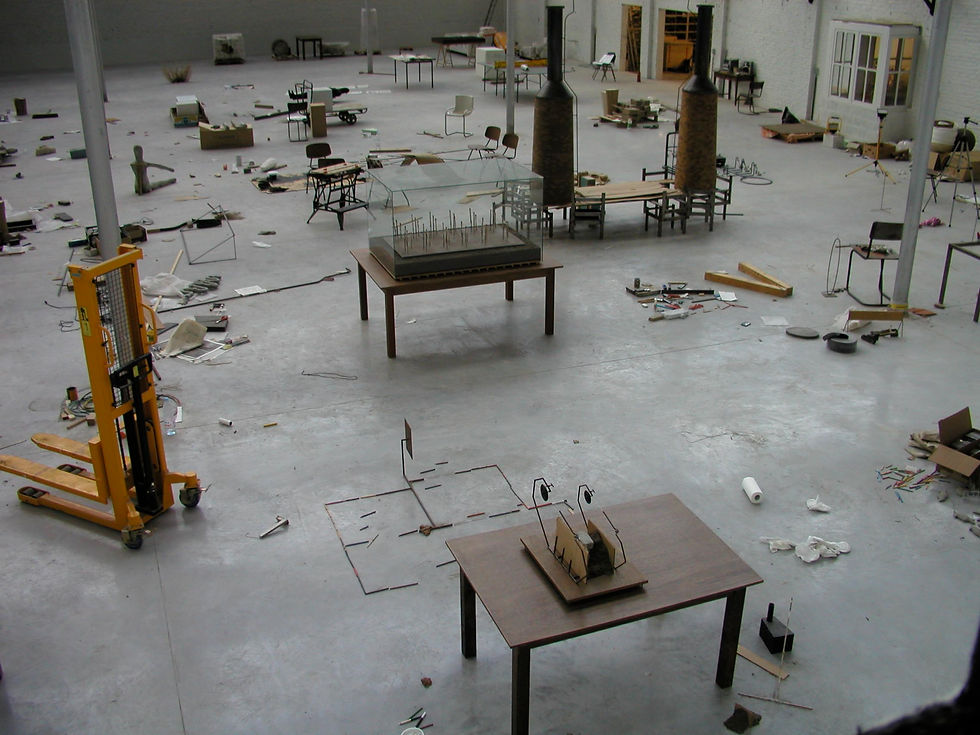
Figure 1: Mark Manders, view of artist's studio with works in progress
The Dutch Artist Mark Manders describes himself as “a human being who unfolds into a horrifying amount of language and materials by means of very precise conceptual constructions”. (1) However, unlike the literary self-portraits of James Joyce in prose, or Dylan Thomas in poetry, Manders' self-portrait is architectural. Having begun his career as a writer, Manders gradually shifted from writing with words to sculpturally writing with objects.

Figure 2: Mark Manders, Inhabited for a Survey (First Floor Plan from Self-Portrait as a Building),
1986 / writing materials, erasers, painting tools, scissors / 8 x 267 x 90 cm
Since 1986, Manders has been constructing a 'self-portrait as a building'. This ongoing project treats his entire body of work as a single, evolving architectural space, where each sculpture or installation acts as a room or piece of furniture within it. He uses this framework to represent the fictional artist 'Mark Manders', an alter-ego he describes as a “neurotic, sensitive individual who can only exist in an artificial world”. (2)
Diagrammatic forms are apparent in many of Manders' projects as the means by which he marshals the "horrifying amounts of language and materials" that his mind is capable of producing. The structural logic to his diagrammatic sculptures imbue them with an air of precision and rigor, despite leaving us guessing at their wildly esoteric functions.

Figure 3: Mark Manders, Finished Sentence, 1998-2006,
iron, ceramic, teabags, offset print on paper, 336 x 185 x 85 cm
Manders appears to use diagrams in his artistic practice in three distinct ways: as a visual aesthetic, as a creative tool for idea generation, and as a means of organising how viewers experience his installations. Aesthetically, many sculptures are formal constructs presented on tables, mechanical supports, or within vitrines. They resemble silent scientific models of events frozen in time, or semi-occult experiments left unattended.
Stephen Berg describes these constructs as “laboratory constellations for uncertainty and unknowable discoveries, production plants for dissident thoughts, transmitters for contacting the fictional”. (3)

Figure 4: Mark Manders, Study for finished sentence, 2004, Offset lithograph, 25,2 × 35,6 cm
The floor plans and delicate pencil drawings show Manders' use of the diagram as a tool for creation and organisation, while the architectural nature of his exhibitions guides viewers through carefully prearranged objects in environments he calls “memory spaces”. (4)

Figure 5: Mark Manders, Drawing with Shoe Movement / Floor Plans
from Self-Portrait as a Building, 2002, Pencil on paper
Manders' artistic practice is what I refer to as "Romantic-Objective," combining his own highly subjective self-expression with an objective and analytical approach mirroring that of science. This framework allows him to explore deeply personal, almost poetic ideas—like capturing a shadow—through a detached, systematic process that mimics a scientific experiment.
Writing about his sculpture "Shadow Study (2)", Manders describes the thought processes that underlie his choice of objects, revealing it to be part exercise in 'material culture' and part daydream. The visual language, however, is distinctively diagrammatic, reminiscent of a highly reduced scientific demonstration.

Figure 6: Mark Manders, Shadow Study (2) 2010,
Metal, porcelain, painted epoxy, and wood / 151 x 65 x 65 cm
"If you think about the evolution of cups, it’s just a beautiful evolution. The first cups were human hands: folded together, they took the water out of the river. The next cups were made from things like hollowed pieces of wood or folded leaves, and so on. The last beautiful moment in the history of the cup was when it got a handle. After that, nothing really interesting happened with cups, just small variations, mainly ornamental. Many generations worked on it, and now you can say that the cup is finished in terms of evolution.
A few times a day there is a cup very close to my upper leg bone, and I slowly discovered that if you turn an empty cup upside down there is a shadow falling out of the cup, falling upon my leg. I wanted to keep this shadow, have it and own it, so I turned it into an image." (5)

Figure 6: Mark Manders, Shadow Study (2) Detail
"Shadow study (2)" subtly references the transparency of bone china and sunlight, creating a three-part visual haiku of an upturned cup pouring its shadow upon a thigh bone. Manders' heightened awareness of the details of everyday life brings to mind an Eden Phillpotts quote: "The Universe is full of magic things, patiently waiting for our senses to grow sharper".
The diagram, in this context, becomes the very tool that sharpens the senses. By isolating and arranging phenomena with clinical precision, the diagrammatic format allows both artist and viewer to perceive the "magic things" hiding in the everyday that Phillpotts describes.
Gallery of selected drawings by Mark Manders:
Drawing with Vanishing Point, 2003, Pencil on Paper, 50 x 65 cm Drawing with Apple, 2009, Pencil on Paper, 110 x 80 cm Mark Manders, Drawing with Vanishing Point, 2017, pencil on paper, 30 x 40 cm Rope Study, 1993, Pencil on Paper, 29.7 x 21 cm Rope Study, 1993, Pencil on Paper, 29.7 x 21 cm Mark Manders, Drawing with iron sticks and socks, 1990-2002, pencil on paper, 29,7 x 21 cm Drawing with Vanishing Point, 2005, Pencil on paper, 65 x 50cm Mark Manders, Drawing with Vanishing Point, 2017, pencil on paper, 30 x 40 cm Drawing with Vanishing Point / Drawing with Cemetery Horse, 1998-2002, Pencil on paper, 50 x 65 cm
References:
1) Manders, M. (2010) Parallel Occurrences / Documented Assignments. Aspen Museum of Art, Aspen Art Museum and The Hammer Museum. p.11
2) van Adrichem, J., Bouwhuis J., Dölle M. (2002) Sculpture in Rotterdam, 010 Publishers, p. 60.
3) Berg, S. (2007) Like the night creeping into a shoe. In: In the Absence of Mark Manders. Berg. S. (Ed.) Hatje Cantz. p. 14.
4) Manders, M. (2003) Quoted in: Koplos J. Mark Manders at Greene Naftali - New York, Art in America, April 2003.
5) Manders, M. http://www.markmanders.org/works-a/shadow-study-2/2/
6) Eden Phillpotts, 1991, A shadow Passes. [OXEP] 2004, Oxford Dictionary of National Biography [Online], Entry: Eden Phillpotts (1862–1960) by Thomas Moult, rev. James Y. Dayananda, Oxford University Press.


Comments