Diagrams of Geometry 3: The shape of numbers and the problem with Mathematics.
❉ Blog post 13 on diagrams in the arts and sciences explores Mathematics' love/hate relationship with diagrams, and Man Ray's favorite 'Shakespearean equations'.

Figure 1: Max Ernst, 'Spies', Plate 10, cover illustration
for Paul Eluard's book of poetry 'Repetitions', published 1922
"A mathematician, however great, without the help of a good drawing, is
not only half a mathematician, but also a man without eyes."
Lodovico Cigoli to Galileo Galilei, 1611
This passionate defense of the diagram comes from a 1611 letter written by the Italian artist Lodovico Cigoli to his lifelong friend, the scientist Galileo Galilei. The two men shared a deep appreciation for both art and science; Galileo was a keen critic of the arts, and Cigoli, an accomplished painter, wrote his own extensive treatise on perspective. Their friendship embodies a moment when visual intuition and scientific proof were seen as partners. The subsequent destruction of Galileo's letters to Cigoli by the artist's heirs, fearing papal condemnation, adds a poignant silence to their dialogue, leaving Cigoli's words to echo through history (1).
Cigoli's statement captures a core tension that would come to define mathematics: a deep reliance on the visual, paired with a profound suspicion of it. But this suspicion was not always the dominant view. In the 17th century, the diagram was a trusted tool of discovery. Over the next two centuries, however, as mathematics strove for absolute, unimpeachable rigor, this partnership between intuition and logic fractured. Mathematicians, particularly in the 19th century, grew wary of "obvious" geometric intuitions, finding cases where they could be deeply misleading. The diagram, once the trusted "eye" of the geometer, was demoted to a mere illustration—a helpful sketch, perhaps, but a treacherous one.
The Problem with Pictures: A Cautionary Tale
This deep-seated mistrust is not just theoretical; it can be perfectly demonstrated by a category of cautionary puzzles. The most famous of these is the "Missing Square Puzzle" (See figure 2). When its colored components are rearranged, an empty square seems to materialize from nowhere, despite the two new shapes appearing to have identical surface areas.

Figure 2: When component parts of triangle A are rearranged,
an empty square appears from nowhere
Another excellent example is the Mitsunobu Matsuyama Paradox (See figure 3), which consists of a square divided into 4 quadrilaterals. When each quadrilateral is rotated 90 degrees clockwise, the new arrangement suddenly gives rise to a small central square, depicted in red.

Figure 3: Mitsunobu Matsuyama's 'Paradox'
Both puzzles work by exploiting the natural limits of human vision. They are not magic; they are powerful reminders that our eyes can be unreliable witnesses. They function by exploiting the fundamental difference between a physical drawing and an ideal mathematical object, which exists only in a fictional world of perfect, zero-thickness lines.
In the "Missing Square," the "hypotenuse" of the large shape is not a straight line at all, but a slightly bent one (See figure 4). In the Matsuyama Paradox, the height and width of the two squares are fractionally different. In both cases, the discrepancy is almost imperceptible to the naked eye, but mathematically, it accounts for exactly the area of the "new" square. A diagram can lie.
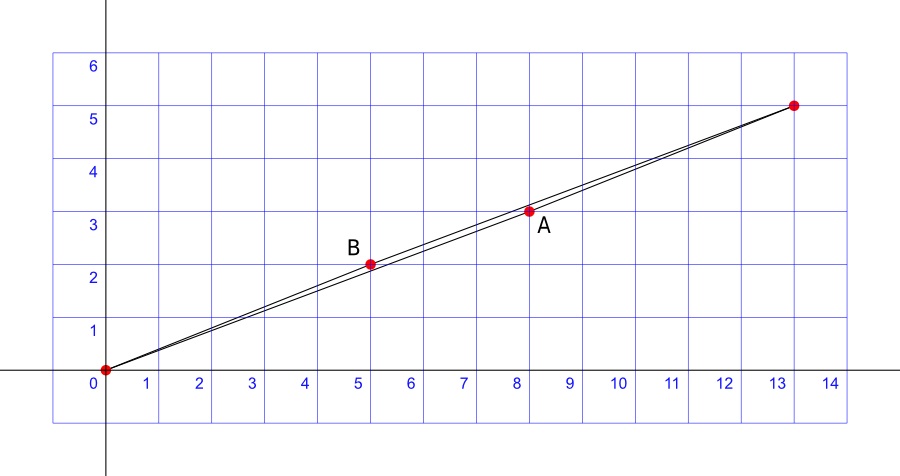
Figure 4: Graph of two false Hypotenuse for triangle A and B, neither of which are truly straight.
The Formalist Backlash
This inherent untrustworthiness of the image led to the rise of mathematical formalism, a movement that sought to separate rigorous proof from fallible intuition. The philosopher and mathematician Gottfried Wilhelm Leibniz, writing in the early 18th century, perfectly articulated this new, anti-diagrammatic stance:
"...it is not the figures which furnish the proof with geometers, though the style of the exposition may make you think so. The force of the demonstration is independent of the figure drawn, which is drawn only to facilitate the knowledge of our meaning, and to fix the attention; it is the universal propositions, i.e., the definitions, axioms, and theorems already demonstrated, which make the reasoning, and which would sustain it though the figure were not there." (2)
For Leibniz and the formalists who followed, the true essence of mathematics lay in algebra and pure logic. The diagram was relegated to the status of a helpful but untrustworthy sketch, a position it largely holds in rigorous mathematics to this day.
It's important to bear in mind our visual limitations and the way our brain makes approximations when reading the diagrams of mathematics. This and the fact that real-world diagrams of perfect mathematical objects ultimately rely upon imperfect lines of ink, chalk or pixels.
However, the diagram remains an extremely powerful tool and a visual guide in providing an insight into the austere and pristine world of mathematical geometry and topology. Leibniz's own notebooks contain an astounding array of diagrammatic sketches that accompany his mathematics, as in figure 5, and the designs and calculations for his 'Universal Calculator', some 200 years before the work of Charles Babbage. For an interesting introduction to the notebooks of Leibniz, see Stephen Wolfram's blog: Dropping In on Gottfried Leibniz.

Figure 5: Diagrams submitted to accompany solutions describing the shape of a Catenary curve, by Gottfried Leibniz (Figure 1 left) and Christiaan Huygens (figure 2 right) to Jacob Bernoulli for publication in the Acta Eruditorum, 1691
The Mathematical Object as Muse
While mathematicians were trying to banish the diagram from their proofs, artists were falling in love with its mysterious beauty. In the 1930s, the Surrealist artist Man Ray, accompanied by Max Ernst, visited the Institut Henri Poincaré in Paris and photographed its collection of 19th-century mathematical models. Languishing in dusty cabinets, these three-dimensional diagrams of complex equations were, for the mathematicians, relics of an outdated, intuitive approach.
For Man Ray, they were revelatory. He described the models as 'so unusual, as revolutionary as anything that is being done today in painting or in sculpture', though he admitted that he understood nothing of their mathematical nature. For the Surrealists, these were the perfect objets trouvés (found objects)—not from a flea market, but from the alien world of pure reason. Divorced from their mathematical function, which Man Ray and Ernst gleefully ignored, they became charged with a new, mysterious, and "suggestively erotic" energy.
When World War II forced him to relocate to Hollywood, Man Ray began a series of paintings based on these photographs. He titled the series the "Shakespearean Equations," a poetic gesture that reframes these cold, logical objects as dramatic actors in a play of pure form, saturated with a new, unintended meaning.
Man Ray, Divers types de points coniques, Mathematical object, 1936-36, Silver Gelatin print, 29x23 Man Ray, Shakespearean Equation, Merchant of Venice (Diderot's Harpsichord), 1948, Oil on canvas, 86 Man Ray, Shakespearean Equation, Romeo and Juliet, 1954 Surface generated by the normals of a rotational paraboloid , Collection Institut Henri Poincaré, c. Models of three-axial ellipsoids of various sizes given in the standard Cartesian coordinates Man Ray, Shakespearean Equation, Merry Wives of Windsor, 1948. Oil on canvas, 61x46cm Imaginary and Real Part of the Derivative of the Weierstrass Function, c. 1900, Collection Institut Real part of the function w=e1/z, c.1900, Collection Institut Henri Poincaré Man Ray, Shakespearean Equation, Julius Caesar, 1948. Oil on masonite, 61x50cm Man Ray, Shakespearean Equation, King Lear, 1948, Oil on canvas, 86.4 x 61 cm Kummer Surface with Eight Real Double Points, Collection Institut Henri Poincaré, c.1900 Surface of Constant width, c.1911, Collection Institut Henri Poincaré Man Ray, Shakespearean Equation, Hamlet, 1949, Oil on canvas, 40.5 x 51 cm Man Ray, Shakespearean Equation, All’s Well that Ends Well, 1948. Oil on canvas, 41x50cm Algebraic Surface of Degree 4, c.1900, Institut Henri Poincaré, Man Ray, Shakespearean Equation, Measure for Measure, 1948. Oil on canvas, cm Man Ray, Shakespearean Equation, Twelfth Night, 1948. Oil on canvas, 87x77cm Man Ray Objet mathématique (1934-1936), Silver Gelatin print
Figure 5: Selection of paintings from Man Ray's 1940's 'Shakespearean Equations' series, shown alongside the models they were based on, from the Institut Henri Poincaré, Paris.
Max Ernst was similarly inspired by mathematical diagrams, particularly those in Eugene Jahnke and Fritz Emde’s 1909 book Tables of functions with formulae and curves. This landmark publication was influential far beyond mathematics; it's said the architect Le Corbusier kept a copy in his studio while designing the iconic Phillips Pavilion. Ernst, however, saw in its pages not architectural inspiration, but a source of poetic transformation, appropriating graphs of Bessel functions for his collage series Paramyths (See figures 6 & 7). For these artists, the diagrams were not failed proofs but successful poems—objects of strange, surreal beauty, liberated from their original function.

Figure 6: La Fable de la Souris de Milo (The Fable of the Mouse of Milo),
Max Ernst, Collage, c.1948
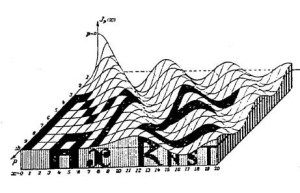
Figure 7: Ausstellungssignet, Max Ernst, 1948.
Pen and Ink on Paper, 5.6x10.5 cm.
Gallery and Afterword
The following selection of geometry diagrams (See figure 8) is taken from the beautifully designed German book "der Geometrie descriptive" c. 1865, by Leopold Mossbrugger. I found this particular copy in an antiquarian bookstore in Prague in 2002, and its elegant lithographs have been a source of inspiration ever since.
Figure 8: A selection of diagrams from the 1933 edition of 'Funktionentafeln Mit Formeln und Kurven', by Eugene Jahnke and Fritz Emde, courtesy of Prof. Andrew Witt.
Afterword: The Digital Renaissance:
Today, the relationship between math and the diagram is changing once more. The dynamism and precision of computer-rendered models have overcome the imprecision that so worried the formalists, sparking a "Digital Renaissance" for the diagram. This is most powerfully seen in the exploration of four-dimensional geometry.
Objects like the tesseract (a 4D analogue of a cube) or the 120-cell (a 4D analogue of a dodecahedron) are impossible for the human mind to fully visualize in three dimensions. We can only understand them as shadows or projections.

Dodecahedron planum vacuum, Lithograph by Leonardo da Vinci,
for Luca Pacioli's 'Divina Proportione', 1509.
Computer-rendered models, however, allow us to rotate these "shadows" in virtual space, building up an intuition for their bewildering and beautiful structure. The work of mathematicians like Jos Leys, who creates stunning videos that dissect and reconstruct the 120-cell, reveals the diagram's power to provide insight into worlds that are otherwise impossible to see.
These new digital tools represent a kind of synthesis, finally resolving the old conflict between visual intuition and logical rigor. The diagrams are now so precise that mathematicians can trust them as laboratories for exploring complex spaces, yet so visually compelling that they create the same sense of "astonishment" and poetics that the Surrealists admired.
This brings us full circle, back to Cigoli's passionate plea to Galileo. The computer has become a new kind of eye, allowing the diagram to visualize the invisible with a clarity and beauty that neither Cigoli nor Leibniz could have ever imagined. The "man without eyes" has finally been given a powerful, new form of digital sight.
[Video of Jos Leys, Dodecahedral Tessellation of the Hypersphere]
Jos Leys, DodecaChedral Tessellation of the Hypersphere:
a dissection of the 120-cell in 12 rings of 10 dodecahedrons
More video and information available here:
References:
1. Panofsky, E. (1955). "Galileo as a Critic of the Arts" in Meaning in the Visual Arts. Doubleday Anchor Books.
2. Leibniz, G. W. (1704). New Essays on Human Understanding. (As cited in various sources on the history of mathematical formalism).

Comments