The Mechanism of Meaning: The Diagrammatic Genius of Arakawa and Gins
Updated: Nov 2, 2025
❉ Blog post 12 on diagrams in the arts and sciences introduces the diagrammatic practice of Arakawa and Gins, the diagram obsessed proteges of Marcel Duchamp.

Figure 1: Blank Lines or Topological Bathing, 1980-81, acrylic on canvas, 254 x 691 cm
© 2017 Estate of Madeline Gins. Reproduced with permission of the Estate of Madeline Gins
While I was an art student in Kyoto, my professor, the artist Usami Keiji, invited a group of us to his cliff-top studio overlooking the Sea of Japan. After a winding drive through the mountains, we were met with an extravagant lunch of champagne, king crab, and one of Usami's arm-waving, hilarious, impromptu speeches on Michel Foucault. Afterwards, a still-smiling Usami slid a book across the table between the open bottles and empty crab shells, saying only, "This... is the work of genius."
The book was 'The Mechanism of Meaning', documenting a decade-long project by the Japanese artist Shusaku Arakawa and his wife, the American poet Madeline Gins. Usami insisted I borrow the book, but over the years, whenever I tried to return it, he would complain that it was too heavy and ask me to look after it until our next meeting. Sadly, Usami passed away in 2012, and I still have his copy, its margins filled with his notes—a personal and lasting connection to the work of these two master diagram-makers.

Figure 2: Figure 2: Arakawa and Marcel Duchamp at Dwan Gallery, New York, 1966
© 2017 Estate of Madeline Gins. Reproduced with permission of the Estate of Madeline Gins and Reversible Destiny Foundation
The Duchamp Connection
Arakawa's arrival in New York is the stuff of legend. He landed at JFK airport in the heavy snow of December 1961 with only a few dollars, a letter of recommendation from his mentor, the surrealist poet Shuzo Takeguchi, and the phone number of Marcel Duchamp. As a parting gift, Takeguchi had given the young artist a book of his poetry; Arakawa would later discover a considerable sum of money hidden amongst its pages.
Using the little English he knew, he made the fated phone call. Duchamp immediately took the young artist under his wing, arranging for Arakawa to stay in Yoko Ono's loft while she was away in Japan. It was there that Arakawa had a chance encounter with John Cage, who had arranged to use the loft as a practice space for his musicians. Duchamp's support didn't stop there; he also introduced Arakawa to Andy Warhol, whose attendance at the young, unknown artist's early exhibitions brought him a great deal of attention.
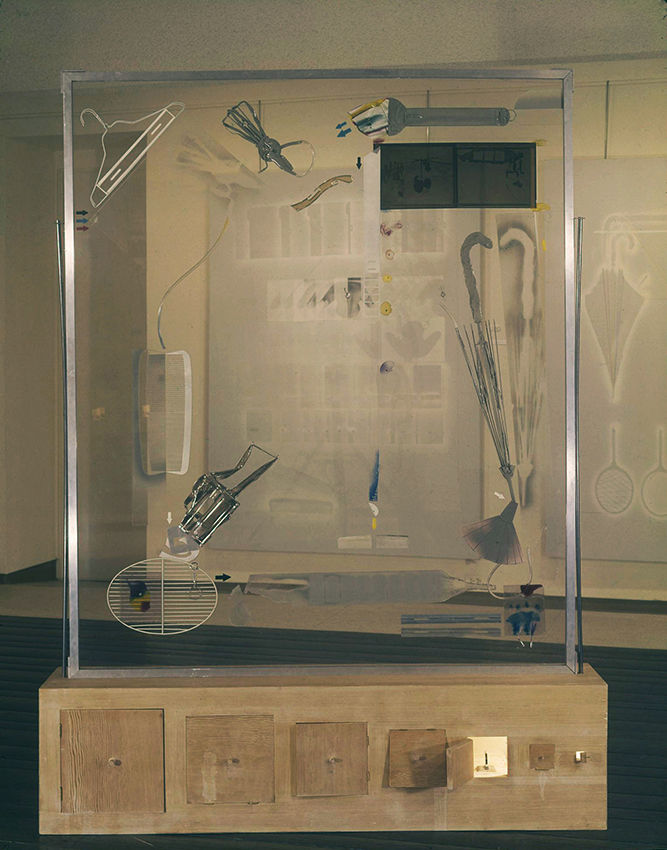
Figure 3: Arakawa, Diagram with Duchamp’s Glass as a Minor Detail (Installation View of 'Arakawa: Diagrams', Dwan Gallery, Los Angeles 1964)
Copyright credit: © 2017 Estate of Madeline Gins. Reproduced with permission of
the Estate of Madeline Gins and Reversible Destiny Foundation.
This mentorship was not just social, but profoundly conceptual. Duchamp's fascination with the reductive, refined aesthetics of the diagram—a product of his own training in mechanical draftsmanship—was a deep influence on Arakawa, who developed his own obsession with the form.
His first solo exhibition in New York at the Dwan Gallery in 1966 was titled simply 'Arakawa: Diagrams', and the Gallerist Virginia Dwan later recalled how she had to dissuade the artist from wanting to sign his paintings 'Diagram', a move she felt was too abstract even for the New York art world (see figure 2).
Early works such as 'Diagram with Duchamp’s Glass as a Minor Detail' (Figure 3) are evidence of Arakawa's desire to both pay homage and at the same time break orbit and seek out his own distinctive style. This inheritance of a diagrammatic art "in service of the mind" would become the foundation for his lifelong collaboration with Madeline Gins, whom he met a year after his arrival.
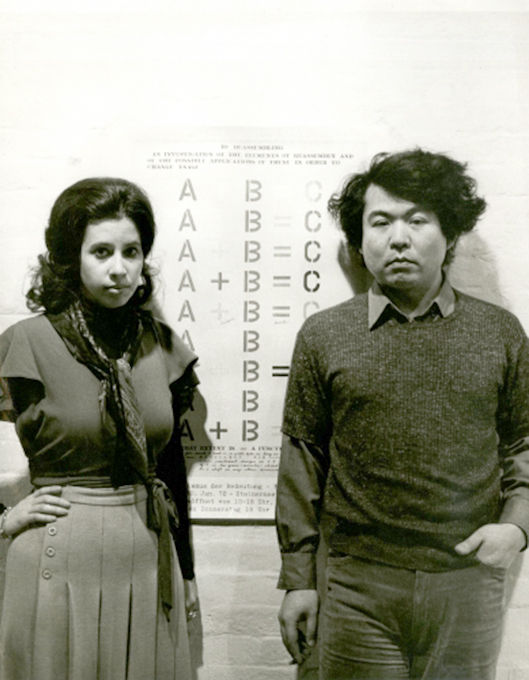
Figure 1: Madeline Gins and Arakawa
in New York, 1972
Copyright credit: © 2017 Estate of Madeline Gins. Reproduced with permission
of the Estate of Madeline Gins and Reversible Destiny Foundation
The Mechanism of Meaning
Together, from 1963 to 1973, they produced their masterwork: The Mechanism of Meaning. * The project consists of eighty large panel paintings that function as a vast, interactive philosophical investigation. One panel serves as an index, dividing the work into sixteen "chapters" that read like a radical new syllabus for the study of consciousness itself:
Neutralization of Subjectivity
Localization and Transference
Presentation of Ambiguous zones
The Energy of Meaning (Biochemical, Physical, and Psychophysical aspects)
Degrees of meaning
Expansion and Reduction - Meaning of Scale
Splitting of Meaning
Reassembling
Reversibility
Texture of Meaning
Mapping of Meaning
Feeling of Meaning
Logic of Meaning
Construction of the Memory of Meaning
Review and Self-Criticism
(* Note: The series actually exists in two different versions, one at the Sezon Museum of Modern Art in Japan and the other in the holdings of the recently established 'Reversible destiny foundation' in New York, based in Arakawa and Gins former studio.)
Thinking Through the Eyes
The panels present viewers with a series of self-contradictory puzzles, instructions, and philosophical provocations. Reminiscent of Zen Buddhist koans, the texts are designed to jolt the mind into a new state of awareness through paradox. Viewers are instructed to "Turn left as you turn right" or "Imagine a thought which bypasses everything."
The work functions as a mirror to one's own thought processes, creating what the author Italo Calvino described as a state where "it is I who begin to feel that my mind is ‘like’ the picture" (1). The French philosopher Jean-François Lyotard perfectly captured their method, stating that the work of Arakawa and Gins “makes us think through the eyes” (2)—an idea that resonates with C.S. Peirce's description of diagrams as "moving pictures of thought." (3)
The Ambiguous Zones of a Lemon
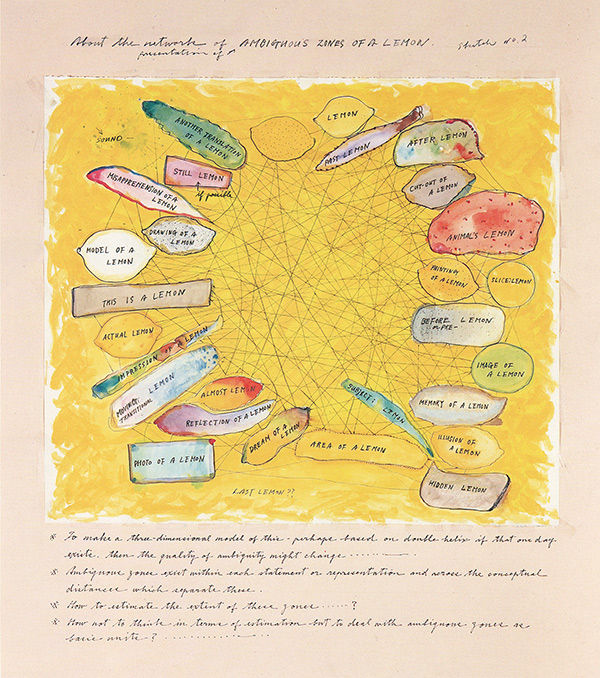
Figure 4: 'About the network of ( perception of ) AMBIGUOUS ZONES OF A LEMON (Sketch No.2)', Ink on paper, from “The Mechanism of Meaning” c. 1963 – 88, Ink on paper (size unknown)
Copyright credit: © 2017 Estate of Madeline Gins. Reproduced with permission of
the Estate of Madeline Gins and Reversible Destiny Foundation.
A sketch for the panel "Ambiguous zones of a Lemon" reveals how their diagrammatic method playfully dissects the complex relationship between objective reality and subjective perception. The work diagrams the many ways a lemon can be considered, forcing us to confront the distinction between primary qualities (which exist independent of an observer, like mass) and secondary qualities (which are given by our senses, like color and taste).
To paraphrase the philosopher Bertrand Russell, when we think we are observing a lemon, we are really observing the effects of the lemon upon ourselves (4).
The panel's categories play with these distinctions, creating a perfect example of a "Romantic-Objective" resonance:
lemon | another translation of a lemon | animal's lemon |
dream of a lemon | still lemon (if possible) | cut-out of a lemon |
area of a lemon | misapprehension of a lemon | after lemon |
hidden lemon | drawing of a lemon | past lemon |
subject: lemon | model of a lemon | sliced lemon |
illusion of a lemon | this is a lemon | reflection of a lemon |
memory of a lemon | actual lemon | photo of a lemon |
image of a lemon | impression of a lemon | reflection of a lemon |
before or pre- lemon | moving / transitional lemon | photo of a lemon |
painting of a lemon | almost lemon | last lemon ?? |
The Scientist-Artists
The Mechanism of Meaning series is best understood as a form of "playful physics", an idea inherited from their mentor, Duchamp. The project uses the objective language and analytical systems of science and philosophy not to find definitive answers, but to creatively test the limits of those systems and reveal their tenuous underpinnings. This was not an attempt to undermine science. On the contrary, Arakawa insisted, "If you want to become an artist, you have to become a scientist first" (5).
Their aim was to creatively probe the boundaries of thought and logic, a project deeply influenced by the philosophy of Ludwig Wittgenstein, whose aphoristic, propositional style in the Tractatus Logico-Philosophicus is immediately apparent when viewing the work .
To map this new poetic-conceptual terrain, Arakawa and Gins created a rich vocabulary of their own, suggesting entirely new fields of study. Rejecting the simple label of "artist," Arakawa pronounced himself a "coordinologist," while Gins described herself as a "biotopologist". They actively engaged in discussions with leading philosophers and scientists, and their work gained significant world-wide success. The Mechanism of Meaning was shown in its entirety at the Venice Biennale in 1970 and again in Germany in 1972.
It was there that the project was praised by the renowned German theoretical physicist Werner Heisenberg, winner of the 1932 Nobel prize for his work on quantum mechanics. Heisenberg, whose famous "uncertainty principle" had fundamentally challenged classical notions of reality, invited Arakawa and Gins to be artists-in-residence at the prestigious Max-Planck-Institute. It's easy to imagine the appeal their work held for a mind accustomed to struggling with the indeterminate and paradoxical nature of reality at its most fundamental level.
Gallery:
Below are a series of selected panels from the 'The Mechanism of Meaning' series.
I would like to thank the Estate of Madeline Gins and the Reversible Destiny Foundation for permission to use these images, and more information can be found at the Reversible Destiny Foundation homepage, or by following their facebook page here.
The foundation recently announced that they will be working together with Gagosian gallery to fully document and represent 'The Mechanism of Meaning' series, in order to bring this important and still highly relevant work Arakawa and Gins to a contemporary audience.

Figure 5: The Mechanism of Meaning, 1.1 Neutralization of Subjectivity, 1963-73/96,
Acrylic and silk screened paper on canvas, 244 x 173 cm
© 1997 Estate of Madeline Gins. Reproduced with permission of the Estate of Madeline Gins

Figure 6: The Mechanism of Meaning, 4.1 The Energy of Meaning, 1963-73/96,
Acrylic and coloured pencil on canvas, 244 x 173 cm
© 1997 Estate of Madeline Gins. Reproduced with permission of the Estate of Madeline Gins

Figure 7: The Mechanism of Meaning, 5.4 Degrees of Meaning, 1963-73/96,
Acrylic, cork, magnetic clip, nails, painted assemblage (Mylar, paper, string, wire, and wood),
paper, rubber strip, wire, wood and measuring stick on canvas, 244 x 173 cm
© 1997 Estate of Madeline Gins. Reproduced with permission of the Estate of Madeline Gins

Figure 8: The Mechanism of Meaning, 5.6 Degrees of Meaning, 1963-73/96,
Acrylic, level, metal chain, newspaper, packaged outdoor thermometer, paintbrush, sponge,
and wristwatch on canvas, 244 x 173 cm
© 1997 Estate of Madeline Gins. Reproduced with permission of the Estate of Madeline Gins

Figure 8: The Mechanism of Meaning, 6.2 Expansion and Reduction - Meaning of Scale,
1963-73/96, Acrylic, neon tubes with plastic electrical unit and oil on canvas, 244 x 173 cm
© 1997 Estate of Madeline Gins. Reproduced with permission of the Estate of Madeline Gins

Figure 9: The Mechanism of Meaning, 7.2 Splitting of Meaning, 1963-73/96,
Acrylic, neon tubes with plastic electrical unit and oil on canvas, 244 x 173 cm
© 1997 Estate of Madeline Gins. Reproduced with permission of the Estate of Madeline Gins

Figure 10: The Mechanism of Meaning, 8.1 Reassembling, 1963-73/96,
Acrylic on canvas, 244 x 173 cm
© 1997 Estate of Madeline Gins. Reproduced with permission of the Estate of Madeline Gins

Figure 11: The Mechanism of Meaning, 8.2 Reassembling, 1963-73/96, Acrylic, cardboard, lightbulb, lightbulb socket, and painted duct tape on canvas, 244 x 173 cm
© 1997 Estate of Madeline Gins. Reproduced with permission of the Estate of Madeline Gins

Figure 12: The Mechanism of Meaning, 10.3 Textures of Meaning 963-73/96,
Acrylic, ball of transparent tape, newspaper, painted photograph, paper record, pencil, plastic cup, razor blade, ring and X-rays on canvas, 244 x 173 cm
© 1997 Estate of Madeline Gins. Reproduced with permission of the Estate of Madeline Gins
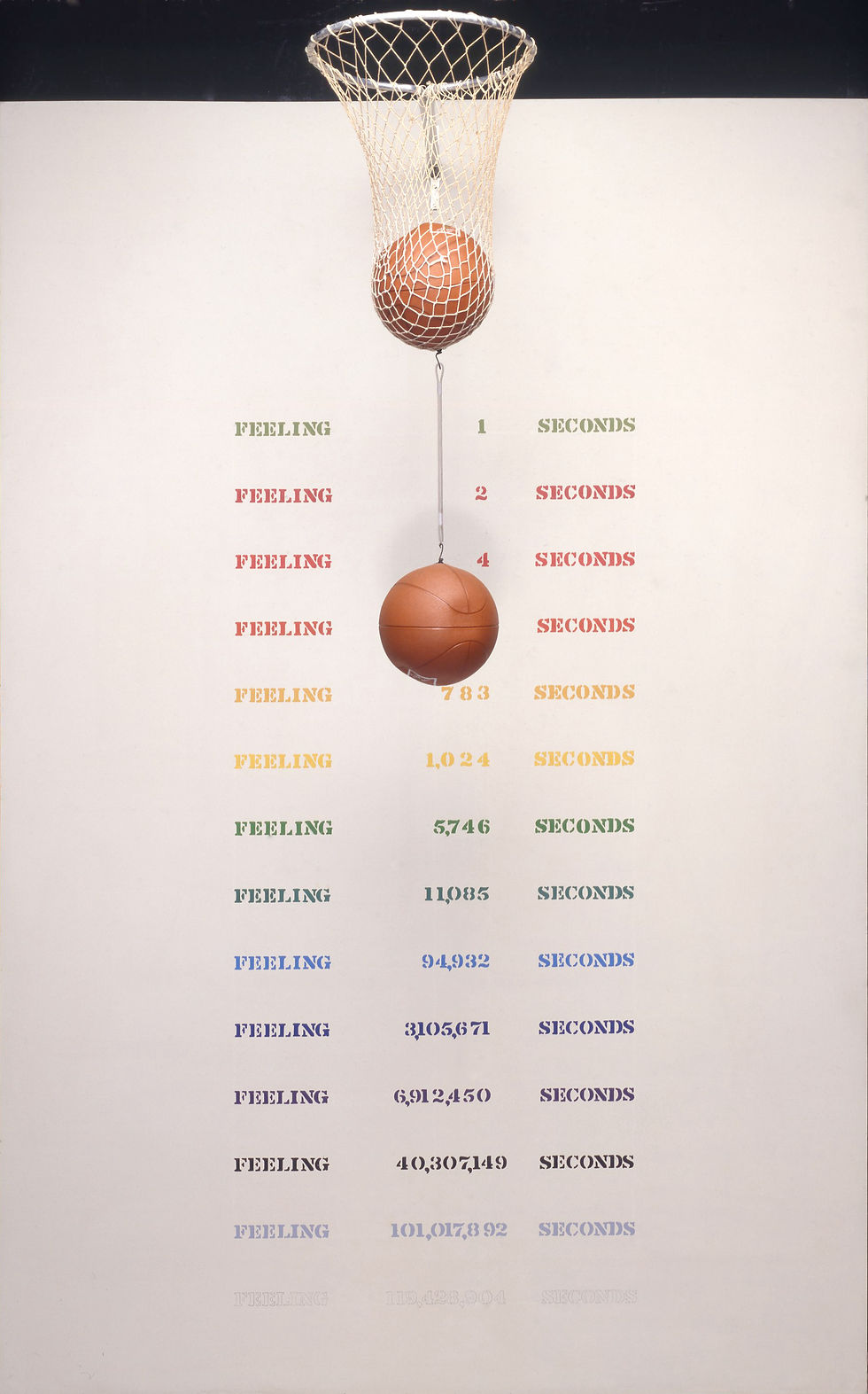
Figure 13: The Mechanism of Meaning, 12.4 The Feeling of Meaning, 1963-73/96,
Acrylic , baseballs, hoop, metal spring and net on canvas, 244 x 173 cm
© 1997 Estate of Madeline Gins. Reproduced with permission of the Estate of Madeline Gins

Figure 14: The Mechanism of Meaning, 14.2 Construction of the Memory of Meaning,
1963-73/96, Acrylic and pencil on canvas, 244 x 173 cm
© 1997 Estate of Madeline Gins. Reproduced with permission of the Estate of Madeline Gins
References:
1) Calvino, Italo. (2007). "The arrow in the mind: A review of the Mechanism of Meaning." In Image, Eye and Art in Calvino: Writing Visibility.
2) Lyotard, Jean-François. (1997). In Reversible Destiny: Arakawa / Gins. Guggenheim Museum Publication.
3) Brent, Joseph. (1998). Charles Sanders Peirce: A Life. Indiana University Press.
4) Russell, Bertrand. (1992). An Inquiry into Meaning and Truth: The William James lectures for 1940 delivered at Harvard University. Routledge.
5) Yamaoka, Nobu (Director). (2010). Children Who Won’t Die [Film].


Comments