The sounds diagrams make: Graphic notations as open works.
Updated: Oct 14, 2025
❉ This is the fifth in a series of blogs that discuss diagrams in the arts and sciences. I recently completed my PhD on this subject at Kyoto city University of the Arts, Japan's oldest Art School.
Feel free to leave comments or to contact me directly if you'd like any more information on life as an artist in Japan, what a PhD in Fine Art involves, applying for the Japanese Government Monbusho Scholarship program (MEXT), or to talk about diagrams and diagrammatic art in general.
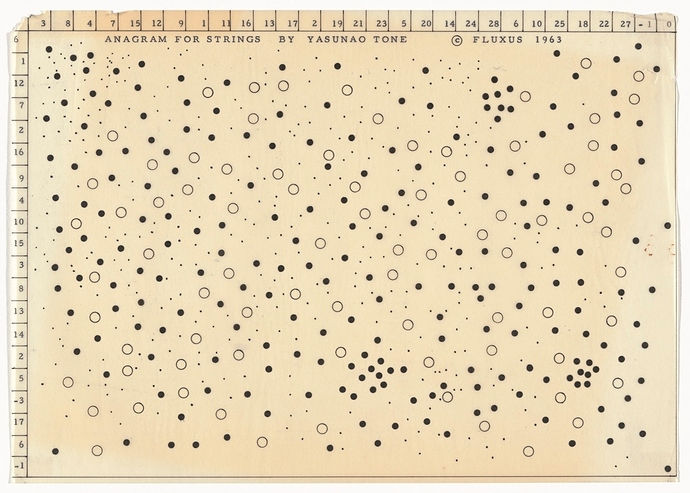
Figure 1: Yasunao Tone, Anagram for Strings. 1961 (Fluxus Edition released 1963)
Master for the Fluxus Edition, typed and drawn by George Maciunas, New York.
In his influential 1989 book, The Open Work, the late, great Umberto Eco introduced the concept of semiotic 'openness'. He used this idea to analyze works that deliberately invite the performer, and even the audience, into the creative process through the use of chance, ambiguity, and multiplicity of meaning. This embrace of indeterminacy within the creative act, Eco argues, marks the boundary between the pre-modern and modern eras in art, music, and literature.
Eco contrasts this new approach with classical composition, which "posits an assemblage of sound units which the composer arranged in a closed, well-defined manner". Traditional scores used conventional symbols to oblige the performer to reproduce the composer's fixed idea. Modern composers, however, began to reject this "definitive, concluded message".
This was not just a stylistic choice but a philosophical one, reflecting a growing 20th-century interest in chance and a questioning of the composer's single, authoritative voice. Rather than chase the impossible goal of lossless information passage from composer to audience, they embraced the multiplicity of interpretations at every stage of the musical process.

Figure 2: Igor Stravinsky's hand written manuscript for The Right of Spring, 1913,
written in the established musical notation of the time
Eco chose several exemplars for his theory, including works by Karlheinz Stockhausen, Luciano Berio, Henri Pousseur, and Pierre Boulez. Their scores were devised to leave key arrangements open, revealing the creative nature of the musicians' role and highlighting the interpretive act of the listener. For Eco, the performer must "impose his judgment on the form of the piece... all this amounts to an act of improvised creation".

Figure 3: Luciano Berio, Sincronie, sketch showing the general articulation
of the composition for string quartet, 1964.
To achieve this openness, composers moved away from the standard, dictionary-like systems of traditional notation. They needed a new language, and they found it in the diagram. Unlike traditional notation, which has a fixed, linear syntax, the diagram is inherently spatial and relational. It can show connections, probabilities, and fields of possibility without dictating a single path, making it the ideal visual language for an "open work."
Their scores no longer behaved like instructions to be read from left to right, but as rhizomatic networks—systems with no fixed beginning or end—from which music arises as an unpredictable, emergent phenomenon.
A particularly striking example of this principle is Karlheinz Stockhausen's 1959 chamber work, Refrain. The score itself is a physical manifestation of the "open work" concept. It is printed on a single folded card sheet with curved staves, which allows a transparent plastic strip containing the titular "refrains" to be superimposed and rotated over the music. By repositioning the strip, performers can introduce these short, disruptive musical phrases at different points in the performance, ensuring that no two readings are identical.

Figure 4: Stockhausen, Karlheinz, Refrain and Klavierstücke I-IV - Two Scores.
London:Universal Edition. 1961. First Edition.
Beyond its innovative notation, the work requires the three musicians to supplement their main instruments (piano, vibraphone, and celeste) with accessory instruments like woodblocks and cowbells. They must also vocalize tongue clicks and sharp phonetic syllables, a technique reminiscent of Japanese theatre.
This unconventional approach stirred some controversy. While the work was generally well-received, a 1962 review by critic Robert Henderson expressed doubt that the labor involved in deciphering the "complex signs" could be justified by the music, dismissing the score as "an amusing musical kaleidescope [sic] for those with unlimited amounts of unoccupied time". This reaction highlights the very tension Eco described: the avant-garde's challenge to the idea of a single, definitive musical message.

Figure 5: Iannis Xenakis, Terretektorh, Distribution of Musicians, 1965, Ink on paper.
Courtesy of the Iannis Xenakis Archives, Bibliothèque nationale de France.
A prolific creator of dense, theory-laden graphic scores was the Greek-French avant-garde composer Iannis Xenakis. Trained as a civil engineer and architect, Xenakis was proficient in creating diagrams and even incorporated mathematical models like game theory and stochastic processes into his music.
Another master was the British experimental composer Cornelius Cardew15. Between 1963 and 1967, Cardew created his monumental graphic score Treatise, a reference to the work of the German philosopher Ludwig Wittgenstein. Treatise consists of 193 pages of beautifully crafted diagrams with no instructions on how they should be interpreted, how many performers there should be, or which instruments should be used.
Treatise Gallery:
The video below is an interpretation of the Treatise Score by the Russian contemporary music group KYMATIC ensemble.
It was by means of the diagram that these composers questioned and expanded our very notions of how music is created, transcribed, and experienced, heralding the dawn of what Eco saw as the true modern period. Below are a selection of graphic scores chosen to highlight the sheer range of novel diagrammatic techniques from this remarkable period in music history.
However, one of these manuscripts predates the others by over 600 years...
Тоru Takemitsu, Voyage, 1973 Тоru Takemitsu, Study for Vibration, 1962 Toshi Ichiyanagi, Music for Electric Metronome, 1960 Toshi Ichiyanagi, IBM for Merce Cunningham, 1960 Toshi Ichiyanagi, Music for Piano Number 1, 1961 Sebastiane Hegarty, Graphic score for Yvon Bonenfant’s Masz project (detail), 2012 Sebastiane Hegarty, Xerographing scores, 2012 Sebastiane Hegarty, Xerographing scores, 2012 Sebastiane Hegarty, Three landscapes and a river: a graphic score, 2011 Roman Haubenstock-Ramati, Alone I, 1974 Roland Kayn, score for allotropie, 1962-64 Roland Kayn, Adaption page from the Score for Endgame, 1973 Roland Kayn, score for Galaxies, 1962 Krzysztof Penderecki, Polymorphia., Long- and short range information exchange and mapping, 1961 Paul Chan, Score for Seventh Light, 2007 Murray Schafer, Score for Tibetan Book of the Dead, 1968 Murray Schafer, Score for Tibetan Book of the Dead, 1968 Paul Chan, Score for Seventh Light, 2007 Paul Chan, Score for Seventh Light, 2007 Paul Chan, Score for Seventh Light, 2007 Josep Maria Mestres Quadreny, L'Estro Aleatorio, 1973-78 Kathleen St. John, Centipede, 1980 Josep Maria Mestres Quadreny, Aronda, 1971 John De Cesare, Transcription of Ave Maria, 1956 John De Cesare, Transcription of Ave Maria, 1956 John Cage, Fontana Mix, 1958 John Cage, score for Imaginary Landscape, No. 5, 1952 Helmut Lachenmann, Gran Torso, 1971 Helmut Lachenmann, Gran Torso, 1971 Helmut Lachenmann, Gran Torso, 1971 George Crumb, Twin suns, 1973 Earle Brown, Calder Piece, 1963-66 Earl Brown, Cross Sections and Color Fields, 1972-75 Conlon Nancarrow, excerpt from the punched tape of Study No. 47, 1969-77 Dick Higgins, Symphony No.245 - Maestoso, 1981 Dick Higgins, Symphony No.245 - Largo, 1981 Dick Higgins, Symphony No.76 - Allegro, 1991 Christian Wolff, Burdocks, page 5, 1970-71 Christian Wolff, Burdocks, page 4, 1970-71 Bogusław Schaeffer, Modell XXIII for piano, 2003 Bogusław Schaeffer, PR–IVIII, 1972. Christian Wolff, For 1, 2 or 3 People, page 4, 1962 Andrzej Dobrowolski, Music for Magnetic Tape and Piano Solo, 1971 Ben Patterson, String Music, 1960 Bogusław Schaeffer, Próbowanie (a!), 1963 Bogusław Schaeffer, Symphony: Electronic Music, 1964 Baude Cordier, Belle, bonne, sage, late 14th century Gottfried Michael Koenig, Klangfiguren I, 1955 Alfred Schnittke, Cantus Perpetuus, 1975 Gottfried Michael Koenig, Klangfiguren I, 1955
References:
1) Umberto Eco, The open work, Translated by Anna Cancogni, Harvard University Press, 1989. p.19.
2) Umberto Eco, Ibid. p.1.


Comments