Diagrams of Geometry - Part 1: Sol LeWitt and the Austere Poetics of Geometry
❉ This is the eighth in a series of blogs that discuss diagrams and the diagrammatic format, especially in relation to fine art. I recently completed my PhD on this subject at Kyoto City University of the Arts, Japan's oldest Art School. Feel free to leave comments or to contact me directly if you'd like any more information on life as an artist in Japan, what a PhD in Fine Art involves, applying for the Japanese Government Monbusho Scholarship program (MEXT), or to talk about diagrams and diagrammatic art in general.
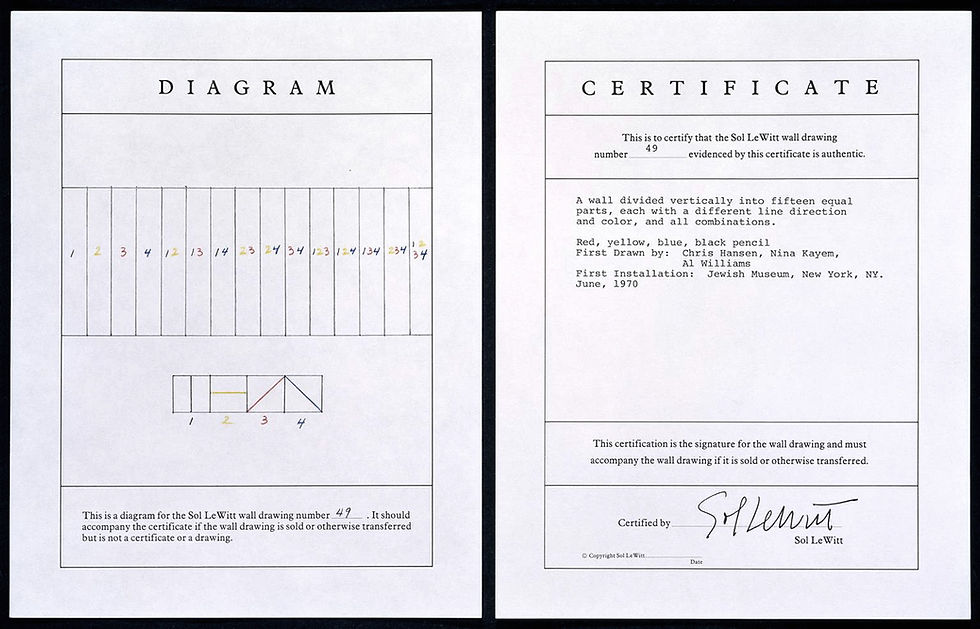
Figure 1: Sol Lewitt, Diagram and certificate for wall drawing #49, A Wall Divided Vertically into Fifteen Equal Parts, Each with a Different Line Direction and Colour, and All Combinations,
1970, Ink on paper
What if an artwork wasn't an object, but a set of instructions? This was the groundbreaking proposition offered by the American artist Sol LeWitt in the late 1960s. He created works that exist primarily as concepts, recorded as precise sets of diagrammatic instructions that specify the combinations of lines, shapes, and colors to be used.
When these instructions are purchased, an accompanying certificate validates the work's authenticity, granting the owner permission to execute the artwork themselves. For LeWitt, the physical manifestation was secondary; the art existed in its purest form as an idea. As he famously stated, “The Idea becomes a machine that makes the art.” (1)
The Idea as a Machine
LeWitt's radical goal was to remove his own subjective taste and arbitrary decisions from the creative act. He believed that by working with a preset plan, an artist could explore an idea to its logical conclusion, eliminating "the arbitrary, the capricious, and the subjective as much as possible" (2).
The diagrammatic instructions were the engine of this process. In works like his wall drawings, the imperfections that arise from human hands transcribing the concept—the slight waver of a line, the subtle variation in pressure—are not seen as mistakes, but as an inherent part of the machine's output.

Figure 2: Sol LeWitt, “Wall Drawing 85.” June 1971. Colored pencil. LeWitt Collection, Chester, Connecticut. First Installation: LeWitt residence, New York
(Art © 2011 The LeWitt Estate /Artists Rights Society, New York)
Mystics, Not Rationalists: The Romantic Paradox
How can such a rigid, systematic approach produce anything other than cold, rational art? This is the central paradox of LeWitt's practice, and it's where his work aligns with what I call "Romantic-Objectivism"—a fusion of objective methods with poetic or irrational goals. LeWitt himself revealed this tension in his 1969 Sentences on Conceptual Art.
He opens not with a defense of logic, but with a surprising declaration: "Conceptual artists are mystics rather than rationalists. They leap to conclusions that logic cannot reach." (3) He goes on to state that while rational judgments repeat themselves, "Irrational thoughts should be followed absolutely and logically." (4) For LeWitt, the diagram and the system were not an end in themselves, but the most rigorous and objective way to execute a fundamentally irrational or intuitive idea.
Case Study: The Poetry of Location

Figure 3: Sol LeWitt, Location of a circle, from the series:
The location of six geometric figures (circle, square, triangle, rectangle, parallelogram and trapezoid). 1974, Set of six etchings, Edition of 25 10 AP.
Accompanying text: 'Location of a Circle'
A circle whose radius is equal to half the distance between two points, the first point is found where two lines would cross if the first line were drawn from a point halfway between a point halfway between the center of the square and the upper right corner and the midpoint of the topside to a point halfway between a point halfway between the center of the square and the midpoint of the right side and a point halfway between the midpoint of the right side and the lower right corner, the second line of the first set is drawn from a point halfway between a point halfway between the center of the square and a point halfway between the midpoint and the left side and the upper left corner and the midpoint of the left side to a point halfway between a point halfway between the center of the square and the upper right corner and a point halfway between the midpoint of the right side and the upper right corner; the second point is found where two lines would cross if the first line is drawn from a point halfway between a point halfway between the center of the square and the midpoint of the bottom side and a point halfway between the center of the square and the lower left corner to a point halfway between the end of the first line of the first set and the end of the second line of the first set, the second line of the second set is drawn from a point halfway between the point where the first two lines have crossed and a point halfway between the start of the first line of the first set and a point halfway between the midpoint of the left side and the upper left corner to a point halfway between the end of the first line of the second set and the midpoint of the bottom side; all whose center is located equidistant to three points, the first of which is located at the center of the square, the second point is located at a point halfway between a point halfway between the center of the square and the upper left corner, the third point is located halfway between the start of the first line of the first set and the end of the first line of the second set.
Such a "Romantic-Objective" approach is perfectly demonstrated in LeWitt's Location series. Each work juxtaposes a pure, Platonic geometric form—a circle (figure 3), a square—with a labyrinthine textual description of its position on the page.
Instead of using the efficient language of mathematical coordinates, LeWitt writes the instructions in convoluted, everyday language, resulting in a single sentence that runs for hundreds of words, becoming almost impossible to mentally reconstruct.
Figures 4-9: Sol LeWitt, The location of six geometric figures
(circle, square, triangle, rectangle, parallelogram and trapezoid).
1974, Set of six etchings, Edition of 25 10 AP.
The text transforms from a set of instructions into a form of "abstract verbal play," a kind of mantra where logical meaning is lost in the rhythmic sound of the words themselves (6). The stark contrast between the visual simplicity of the geometric diagram and the baffling complexity of its description creates a poetic resonance. It's no surprise that LeWitt himself remarked that he considered this series his “poetry”(7)
Historical Echoes:
This tension between a pure geometric diagram and its dense textual explanation has a fascinating historical precedent. Over 450 years earlier, a page from the notebooks of Leonardo da Vinci shows a simple geometric proof accompanied by a long, convoluted textual description explaining the relationship between the triangles.
While Leonardo's goal was purely analytical, the visual and conceptual rhyme with LeWitt's work is striking, reminding us that the dialogue between visual and verbal logic has a long and rich history.

Figure 10: Leonardo da Vinci, Profile of a Man, plant, geometric figures etc.
(also known as the ‘Theme Sheet’) (detail)
c. 1448, pen and ink, Windsor Castle, The Royal Collection.
Accompanying text: ( Located in the bottom left hand corner of image above )
" The triangle abc is similar to a third of the large triangle dbf because it is made up of two equal parts, that is abe and bec, and the large triangle is made up of 6 parts, and each of these parts is equal to each of the said 2, and the 6 parts are these: dec and ced and so on, in similar parts. And if the triangle abc had its sides similar to its axis, cb, the triangle dbf would receive in itself 4 of these triangles, whereas at present it receives 3; thus to see the difference from one of the triangles which are ¼ of the large one and one of those which are ⅓, have the large triangle divided in to twelfths, and say that it is 12 twelfths. Then say that the triangle which is a ⅓ of it is 4 of these twelfths and the triangle that is a ¼ of this large one contains three of these twelfths, so that the difference between 4 and 3 is one twelfth, whence we can say that the smaller is ¾ of the larger. "
Gallery:
The following selection of geometry diagrams are taken from the beautifully designed German book "Der Geometrie Descriptive" c.1865, by Leopold Mossbrugger. Fig.a in image 3, presents the various line types employed during the construction of these ideal types of mathematical forms, and the diagrammatic systems used to bring them into being as two dimensional lithographs upon the page. This particular copy was purchased from an antiquarian bookstore in Prague, the capital the Czech Republic, in 2002
.
References:
1) LeWitt, S. (1967) Paragraphs on Conceptual Art. Art Forum. June, 1967
2) Ibid
3) LeWitt, S. (1969) Sentences on Conceptual Art. In: Art and Language, No. 11. (May 1969) p. 11
4) Celant, G. (2009) (First published:1988) The Sol LeWitt Orchestra. In: Sol LeWitt: 100 views. Eds. Markonish, D. and Cross, S. MASS MoCa in association with Harvard University Press, p. 27.
5) de Waal, C. (2013 ) Peirce: A guide for the perplexed, London: Bloomsbury Academic. p.88.
6) Baume, N. (2001) Sol LeWitt: Open cubes. Exhibition Catalogue. Hartford: Atheneum Museum of Art.
7) Lewitt, S. quoted in: LeWitt and Miller Keller, A. Excerpts from a Correspondence, 1981 – 1983. In: Suzanne Singer, ed., Sol LeWitt wall drawings, 1968 – 1984. Amsterdam: Stedelijk Museum, Eindhoven: Van Abbemuseum, Hartford: Wadford Atheneum, 1984. p. 18-25.


Comments