J.M.W. Turner P.P. (Professor of Perspective)
Updated: Oct 25, 2025
❉ This is the first in a series of blogs that discuss diagrams in the arts and sciences. I recently completed my PhD on this subject at Kyoto city University of the Arts, Japan's oldest Art School.
Feel free to leave comments or to contact me directly if you'd like any more information on life as an artist in Japan, what a PhD in Fine Art involves, applying for the Japanese Government Monbusho Scholarship program (MEXT), or to talk about diagrams and diagrammatic art in general.
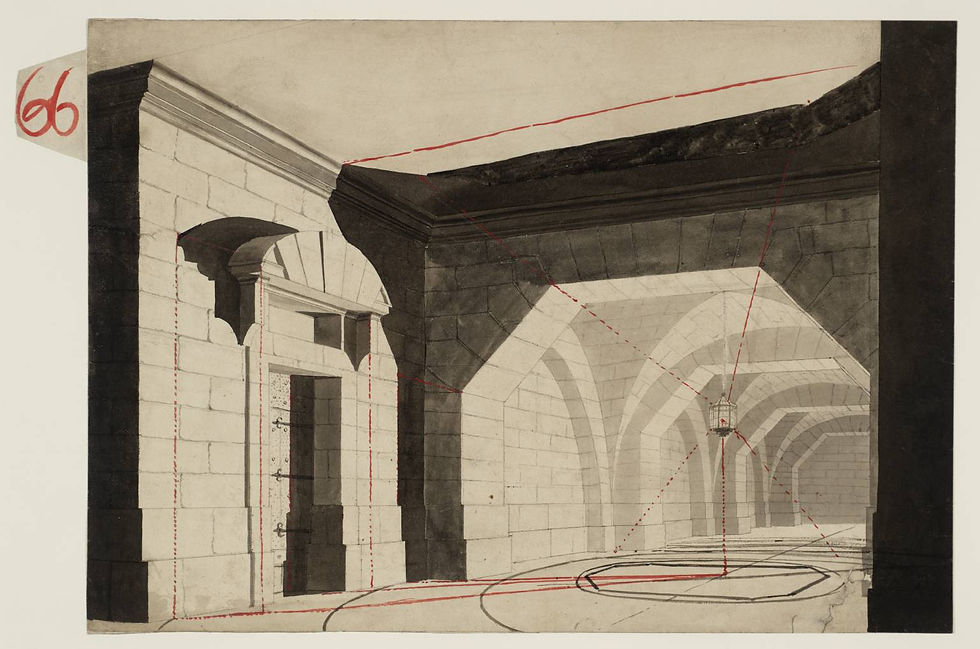
Figure 1: JMW Turner, Lecture Diagram 66- Interior of a Prison
(after Giovanni Battista Piranesi) c.1810
The name Joseph Mallord William Turner (1775-1851) summons images of sublime, near-abstract tempests and landscapes dissolving into ethereal light. He is, in the popular imagination, the archetypal Romantic painter, a master of atmosphere and emotion. It is therefore a fascinating paradox that for thirty years, from 1807 to 1837, this very artist held the rigorously technical post of Professor of Perspective at the Royal Academy in London. This role, and the body of work it produced, reveals a crucial, often overlooked, dimension of his genius: the analytical mind that underpinned his revolutionary vision.
Though he delivered only twelve full lecture courses during his three-decade tenure, the professorship was a position of immense pride for Turner. He had earned his credentials not through formal academic training, but through practical application. As a young man in the 1780s, he was apprenticed to the architectural draughtsman Thomas Malton the Younger, a master of perspective, and later worked for architects like Thomas Hardwick and James Wyatt. This foundation in the precise, mathematical rendering of space gave him the technical authority for the role—an authority he valued so highly that he would sometimes sign his works with the post-nominal letters ‘PP’ (1).
Mithematics
Turner’s preparation for his lectures was exhaustive. Over a period of three years, he created more than 170 didactic diagrams. These were not mere sketches, but large-scale visual aids, approximately 60 x 90 cm, which were displayed on a stand by assistants as he spoke. They ranged from geometric proofs and studies of conic sections to architectural interiors and analyses of reflection and refraction.
Yet, by all accounts, the lectures themselves were a notorious failure. Contemporary reports describe a disorganized, mumbling speaker who was difficult to comprehend. Audience members complained of his "inane lecturing style" and his tendency to stray wildly from the topic (2, 3). His fellow Academicians openly mocked his vulgar pronunciation—famously, he pronounced "mathematics" as "mithematics." Turner, the visual virtuoso, was simply not a master of the spoken word. His genius resided in a different mode of communication.
Optics and Perspective
It is in his diagrams that Turner’s true lecture is found. In stark contrast to his verbal delivery, these drawings are models of clarity, precision, and intellectual elegance. As one student in attendance remarked, Turner's diagrams "were truly beautiful, speaking intelligibly to the eye if his language did not to the ear" (5). They are refined, lucid, and possess a striking graphic modernity. Here, Turner’s struggle to articulate the complex laws of optics and perspective verbally is resolved through the sheer eloquence of the visual form.

Figure 2: JMW Turner, Lecture Diagram 20- Conic Sections
(after Thomas Malton Senior) c.1810)
These works are exceptional examples of what the American philosopher and logician Charles Sanders Peirce would later term "Moving Pictures of thought" (4). For Peirce, a diagram is not a static illustration but a dynamic icon of relations. It allows the observer to trace an argument, to experiment with a hypothesis, and to model abstract concepts in the mind's eye. Turner's diagrams do precisely this; they render the logic of perspective visible, demonstrating the principles of optics in a way that words could not. They are the argument itself.

Figure 3: J.M.W. Turner, Self-Portrait, c.1799,
oil on canvas, 74 x 58 cm, Image in Public Domain
Romantic Objectivism
This series of drawings occupies a fascinating and critical position in art history. They demonstrate that one of the preeminent Romantic painters, an artist celebrated for his dramatic and subjective vision, also possessed an unwavering command of the objective and technical rules of optics. This reveals a fundamental tension at the heart of his practice. As the art historian Brian Lukacher notes, Turner believed that the "mathematical rules of perspective... crumble before the higher metaphysics of the artistic mind fixed on the immeasurable."
Turner’s diagrams, therefore, were not just tools for teaching; they were a laboratory for understanding the very structure of vision. He mastered the rules so completely that he knew precisely how and when to break them for emotional and atmospheric effect. The objective knowledge contained in these diagrams was the essential scaffold upon which he built his sublime, romantic landscapes.
This powerful synthesis is a perfect historical example of an artistic approach I call 'Romantic-Objectivism' in my own doctoral research—a practice that mediates between subjective, metaphoric self-expression and the detached rigor of objective investigation. Turner's work reminds us that the diagram has long been a fundamental mode of knowledge. When adopted by artists, it not only transforms artistic practice, but also transforms our very notion of what the diagram itself can be.
Gallery:
Perspective Method for a Cube (after Jean Pélerin) c.1810 Lecture Diagram 75- Interior of a Prison c.1810 Lecture Diagram 70- A Ruined Amphitheatre c.1810 Lecture Diagram 67/68- Stone Recess with Shadows c.1810 Lecture Diagram 58- Perspective Construction of Pulteney Bridge, Bath (after Thomas Malton Junior) c Lecture Diagram 52- Perspective Constructions of an Ionic Capital (after Thomas Malton Senior and Ja Lecture Diagram 54- Perspective Construction of a Corinthian Capital (after Thomas Malton Senior) c. Lecture Diagram 51- Perspective Construction of a Doric Entablature (after Thomas Malton Senior) c.1 Lecture Diagram 48- Pedestal of the Column of Antoninus Pius c.1810 Lecture Diagram 42- Perspective Construction of a Tuscan Entablature c.1810 Lecture Diagram 40- Perspective Method for a Circle (after Thomas Malton Senior) c.1810 Lecture Diagram 37- Perspective Method for a Pentangular Prism (after Dr Brook Taylor) c.1810 Lecture Diagram 36- Basic Perspective Construction of a House c.1810 Lecture Diagram 36- A House in Perspective c.1810 Lecture Diagram 33- Perspective Method for a Cube (after Jacopo Vignola) c.1810 Lecture Diagram 30- Perspective Method for a Cube (after Samuel Marolois and Jean-François Niceron) Lecture Diagram 29- Perspective Method for a Cube (after Guidobaldo del Monte) c.1810 Lecture Diagram 22- Geometry of the Parabola (after John Hamilton) c.1810 Lecture Diagram 21- Representation of a Globe in Perspective (after Thomas Malton Senior) c.1810 Lecture Diagram 19- Conic and Cylindrical Sections (after Thomas Malton Senior) c.1810 Lecture Diagram 18- Principles of Rectilinear Perspective (after Thomas Malton Senior) c.1810 Lecture Diagram 17- Principles of Rectilinear Perspective (after Thomas Malton Senior) c.1810 Lecture Diagram 15 The Terminology of Perspective of Dr Brook Taylor c.1810 Lecture Diagram 14 The Terminology of Perspective of Joseph Moxon c.1810 Lecture Diagram 11- Spheres at Different Distances from the Eye (after Thomas Malton Senior) c.1810 Lecture Diagram 10- Proportion and Design of Part of Raphael's 'Transfiguration' c.1810 Lecture Diagram 8/1- Ground Plan of a Stoa or Portico (after James Stuart) c.1810 Lecture Diagram 1- Cross-Sections of the Human Body (after Albrecht Dürer) c.1810 Lecture Diagram 2- Cross-Section of the Human Body (after Albrecht Dürer) c.1810 Indications of Transfer Process c.1810
References:
Egerton, J., & Ellis, C. (1980). ‘JMWT PP’: A Selection of Drawings Made by Turner to Illustrate his Royal Academy Lectures as Professor of Perspective [Exhibition catalogue]. Tate Gallery, London, p.1.
"Mr Turner's lectures at the Royal Academy." (1816, February 1). The New Monthly Magazine, p.60.
Annals of the Fine Arts, vol.4, London 1820, p.98.
Peirce, C.S. Collected Papers, CP 4.8-11.
Redgrave, R. (1866). A Century of British Painters, p.95.
For more information See:
Andrea Fredericksen, ‘Royal Academy Perspective Lectures: Sketchbook, Diagrams and Related Material c.1809–28’, June 2004, revised by David Blayney Brown, January 2012, in David Blayney Brown (ed.), J.M.W. Turner: Sketchbooks, Drawings and Watercolours, Tate Research Publication, December 2012, https://www.tate.org.uk/art/research-publications/jmw-turner/royal-academy-perspective-lectures-sketchbook-diagrams-and-related-material-r1131857
(Accessed 18 March 2016)
Comments