Clouds, Glands, Tributaries: A Three-Part Meditation on Water
❉ Blog post 11 on diagrams in the arts and sciences examines a three-part drawing I made in 2007 titled 'Clouds, Glands, Tributaries'. This minimal, diagrammatic meditation on water turned out to be a turning point in my artistic practice, bringing together my interest in encyclopedias, diagrams, the sciences, and romanticism for the first time.

Figure 1: Michael Whittle, Clouds, glands, tributaries, 2007, Ink on Paper, 133 x 125.5 cm
My earliest experiences with the great divide between scientific objectivity and artistic subjectivity were stark and contradictory. As an undergraduate biochemistry student, I was cautioned by a professor for using "poetic" adjectives like 'subtle' and 'profound' in a scientific essay. Science, he told me, was a rule-based game where subjectivity was to be avoided at all costs.
Five years later, at the Royal College of Art, the vice-chancellor—himself a former biochemist—described one of my drawings as too 'cold' and 'clinical'. It wasn't until I created the drawing Clouds, Glands, Tributaries many years later that I felt I had found a way to bridge these two seemingly irreconcilable worlds.
The Visual Haiku
I came to realize that my approach to drawing shared a deep structural similarity with the writing of Japanese Haiku 俳句. The Haiku poet must remain entirely objective, presenting observations without directly revealing their own feelings. The true power of a successful haiku lies in the "subjective void" it creates, a space left for the reader to fill with their own experience.
This principle is perfectly captured in a poem by the 17th-century poet Nozawa Boncho: “The brushwood, though cut for fuel, has started to bud.” Boncho was a leading disciple of the legendary poet Matsui Basho. The fact that he was also a physician underscores the deep connection between the precise observation of a scientific mind and the creation of profound, resonant art.

Figure 2: Nozawa Boncho (1640–1714)
"A cold winter rain— a mouse scampers over the koto strings".
Considered as a visual haiku, Clouds, Glands, Tributaries is composed of three tiers of objective, scientific diagrams, connected abstractly by the theme of water.
Clouds (Meteorology):

Figure 3: Clouds, glands, tributaries (detail 1)
14 cyclones rotating towards the viewer, drawn as weather diagrams
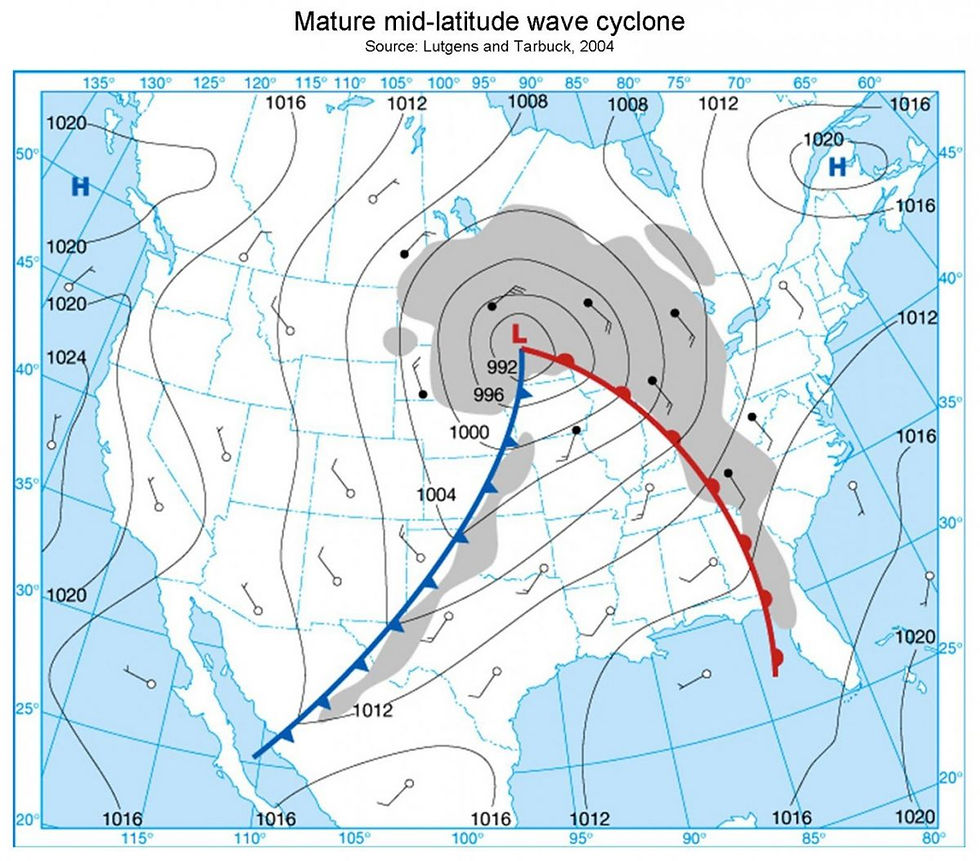
The top level depicts storm clouds in the 'comma cloud pattern' of Mid-latitude cyclones, which, like a haiku, references a season (winter).
While weather charts show these formations from above, here they are stood vertically, rotating inwards toward the viewer.
Figure 4: Mature mid-latiude wave cyclone
Source: Lutgens and Tarbuck, 2009

Figure 5: Clouds, glands, tributaries (detail 2)
Collision of cold front and warm front as part of the formation of a cyclone
Glands (Biology): .
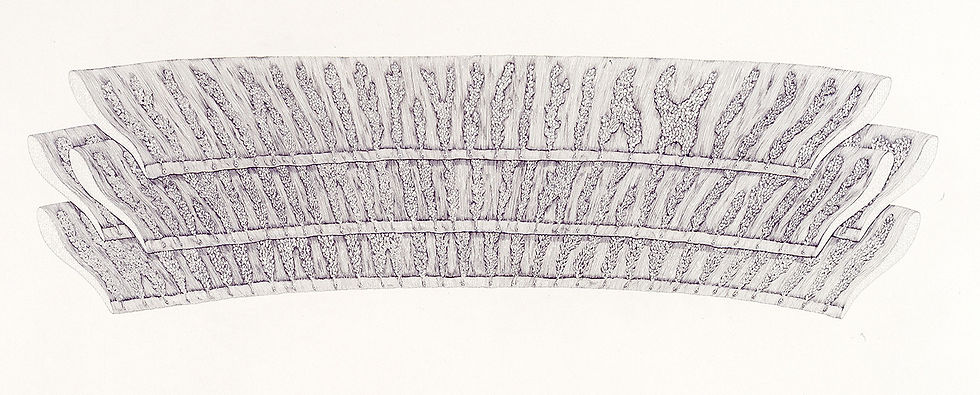
Figure 6: Clouds, glands, tributaries (detail 3)
Four inner eyelids complete with Meibomian (tarsal) glands
Beneath this, on a completely different scale, are the Meibomian glands of the human inner eyelid. These glands secrete an oily substance that traps the 'precorneal film'—a minuscule layer of salt water 0.003 mm thick through which we view the world

Figure 7: Medical diagram of the inner eyelids showing Meibomium (tarsal) glands and their ducts,
and also the Lacrimal gland which creates tears (frontal view and cross section)

Figure 8: Clouds, glands, tributaries (detail 4)
Inner upper eyelids complete with Meibomian (tarsal) glands and ducts
Tributaries (Geology):
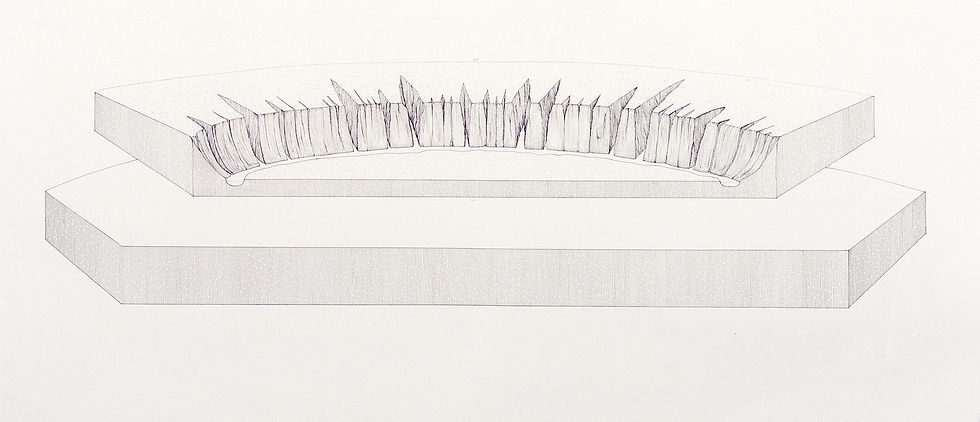
Figure 9: Clouds, glands, tributaries (detail 5)
Geological diagram depicting the theory of river tributary formation and flood plain
The base layer shifts scale once more to depict a geological cross-section showing the erosion of bedrock by a river over geological time, forming a complex network of tributaries.

Figure 9: Clouds, glands, tributaries (detail 6)
The Poetics of the Diagram
This act of curating carefully selected diagrams was my first attempt to explore poetic resonance among fragments, in much the same way Diderot’s Encyclopédie could generate a "wild surrealism" through the unexpected juxtaposition of its plates. My drawing shares two key elements of what Roland Barthes called the "poetics of the encyclopedic image". The first is the poetry found in "a certain power of disproportion" —the abrupt, astonishing shifts in scale that diagrams allow, placing the vastness of a cyclone alongside the microscopic anatomy of an eyelid. The second is the poetics of "immobility," where all movement is arrested, leaving the eye to wander over the crystallized structures.
As an "open work" in Umberto Eco's terms , the drawing takes on a plurality of readings. The diagrams are released from their original referential rhizomes and suspended in the white ground of the paper, which becomes, as Bender and Marrinan describe, "an arena of potentiality that fosters connections without fixing them or foreclosing thought experiment”. Raindrops from the clouds and tears from the glands are suggested, both playing on the idea of erosion over time. The four overlapping eyelids also create a spherical negative space, a void that suggests the very eyeball through which we perceive the world.
This idea of seeing through another's eyes resonates with a formative experience. As a student, I had the opportunity to visit a collection of medical specimens. One exhibit consisted of slices of a human head, each about 3cm thick and encased in glass. By removing the front slice, I could hold it up to my face and literally look through another human's eye sockets. That moment—of clinical observation combined with the profound, intimate act of seeing through another's eyes—stayed with me. It wasn't until I created the drawing Clouds, Glands, Tributaries many years later that I felt I had found a way to bridge these two seemingly irreconcilable worlds.
The drawing depicts a landscape stripped bare of its subjective qualities, a viewpoint resembling that of Caspar David Friedrich’s Romantic painting Wanderer above the sea of fog. Friedrich’s Romanticism was also objective in nature, “intensively contemplative, focused inwardly by melancholy, but created through a strict formalism”. By using a strict, formal, and objective language, the drawing invites the viewer into that "subjective void" of the haiku. It asks to be completed by their own sensations, aiming for what Francis Bacon described as the goal of all art: "...a thing to be as factual as possible and at the same time as deeply suggestive or deeply unlocking of areas of sensation..." .
Gallery:
To see just how subtle, intricate and profound biochemical pathways really are, it's worth following the link below to two of my favourite diagrams. Compiled by Gerhard Michal of the Boehringer Mannheim company, they were originally published as huge wall posters, but are now available for free in an online, interactive form.
The two charts 'Biochemical Pathways' and 'Cellular and Molecular Processes', are both daunting in their scale and beauty, but it's worth remembering that if all known molecules within the human cell were to be included on a chart at this scale, it would need to be far larger than a football pitch in size (and probably 3-D).
Click on the images below to access the online versions of the charts:

References
1. Barthes, R. (1980). New Critical Essays (R. Howard, Trans.). Hill and Wang.
2. Eco, U. (1989). The Open Work (A. Cancogni, Trans.). Harvard University Press.
3. Bender, J., & Marrinan, M. (2010). The Culture of the Diagram. Stanford University Press.
4. Ackerly, C. (2004). Obscure Locks, Simple Keys: The Annotated 'Watt'. Journal of Beckett Studies.
5. Bacon, F. (1975). In D. Sylvester (Ed.), Francis Bacon: Interviewed by David Sylvester. Thames & Hudson.


Comments